
Choosing an air conditioner is not simply a matter of comparing prices or selecting the highest cooling capacity. An AC is a thermodynamic system that transfers heat from an indoor space to the outside environment, and its real-world performance depends on several factors—including room size, insulation, outdoor temperature, installation quality, energy efficiency, humidity, and how frequently the system is used.
For Indian homes, split ACs and window ACs remain two of the most common choices. Both can provide effective cooling, but their construction, installation requirements, noise levels, energy consumption, maintenance, and suitability for different rooms can vary considerably.
This guide explains the technical differences between split and window air conditioners and the factors worth considering before buying one.
How Does an Air Conditioner Actually Work?
Before comparing split and window ACs, it helps to understand the basic refrigeration cycle.
Most conventional air conditioners use a vapour-compression refrigeration cycle consisting primarily of:
- Compressor
- Condenser
- Expansion device
- Evaporator
The refrigerant circulates through these components and changes pressure and temperature during the process.
1. Evaporator
The indoor evaporator absorbs heat from the room air. A blower pushes warm indoor air across the cold evaporator coil.
The refrigerant inside the coil absorbs thermal energy and evaporates.
2. Compressor
The compressor increases the pressure and temperature of the refrigerant vapour before sending it to the condenser.
The compressor is one of the major electrical loads in an AC.
3. Condenser
The condenser releases the absorbed heat to the outdoor environment. The refrigerant changes from a high-pressure vapour into a liquid.
4. Expansion Device
The expansion valve or capillary arrangement reduces refrigerant pressure. This causes a significant reduction in refrigerant temperature, preparing it to absorb heat again in the evaporator.
The cycle then repeats.
In simplified terms:
Room heat → Evaporator → Refrigerant → Compressor → Condenser → Outdoor air
The AC isn’t “creating cold air.” It is moving heat from one location to another.
Split AC vs Window AC: The Fundamental Difference
The main difference is physical configuration.
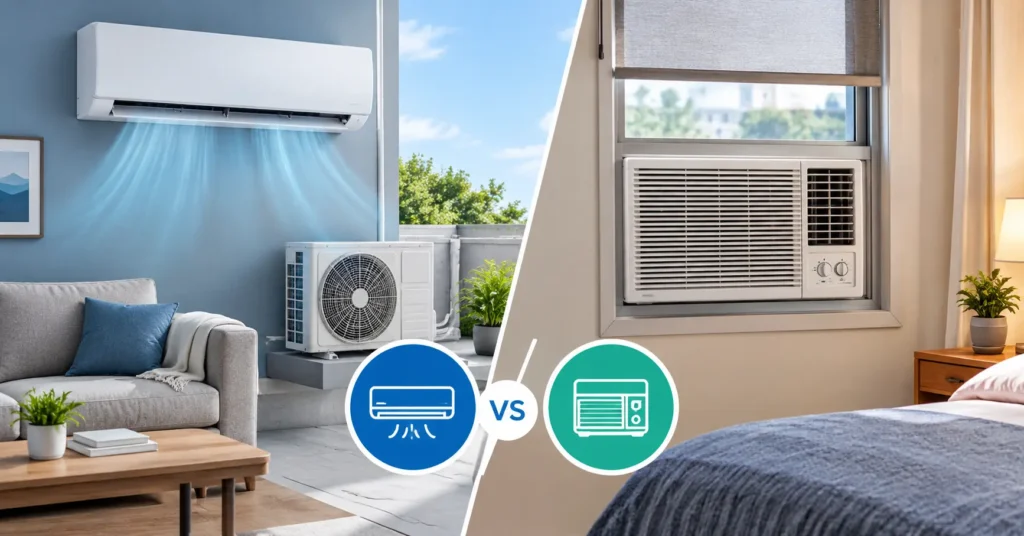
A window AC contains the compressor, condenser, evaporator, blower, and associated components in a single cabinet.
A split AC separates the system into two major units:
- Indoor unit
- Outdoor unit
The indoor unit generally contains the evaporator coil and blower, while the outdoor unit contains the compressor, condenser and condenser fan.
This separation provides several practical advantages but also makes installation more complicated.
Technical Comparison
| Feature | Split AC | Window AC |
|---|---|---|
| Basic design | Two separate units | Single cabinet |
| Installation | More complicated | Relatively simple |
| Wall opening | Smaller refrigerant-pipe routing required | Large opening generally required |
| Noise | Usually lower indoors | Usually higher |
| Appearance | More integrated | More noticeable |
| Installation cost | Usually higher | Usually lower |
| Maintenance access | Indoor/outdoor components separate | Components concentrated in one unit |
| Portability | Fixed installation | Can be removed/reinstalled relatively easily |
| Suitable for | Bedrooms, living rooms, offices | Smaller rooms and straightforward installations |
| Outdoor unit | Required | Integrated |
| Air distribution | Generally better | More localized |
| Installation dependency | High | Moderate |
These are general characteristics; exact performance varies significantly between models.
1. Cooling Capacity: How Many Tons Do You Need?
One of the most important decisions is choosing the appropriate cooling capacity.
AC capacity is commonly expressed in tons, although technically the cooling capacity is better represented using units such as BTU/h, kW, or watts.
A “1-ton” AC does not mean that the machine weighs one ton.
Historically, one refrigeration ton represents approximately:
12,000 BTU/h
Therefore:
- 1 ton ≈ 12,000 BTU/h
- 1.5 ton ≈ 18,000 BTU/h
- 2 ton ≈ 24,000 BTU/h
However, room area alone should not determine the capacity.
What Determines AC Capacity?
The required cooling capacity depends on the room’s total heat gain.
Important factors include:
Room Size
A larger room generally requires greater cooling capacity.
Ceiling Height
A room with a high ceiling contains more air volume than a standard-height room.
Solar Heat Gain
Rooms receiving strong direct sunlight can require additional cooling capacity.
South- and west-facing rooms can experience particularly high afternoon heat loads in many parts of India.
Number of Occupants
People continuously release heat into the room.
A room occupied by several people therefore has a higher cooling load than an empty room.
Electronic Equipment
Computers, televisions, gaming systems, refrigerators and other electrical devices convert much of their electrical energy into heat.
Insulation
Poorly insulated walls, roofs and windows allow more heat to enter the room.
Windows
Large glass surfaces can substantially increase solar heat gain.
Local Climate
An AC operating in a hot region may experience a substantially different load from one operating in a relatively mild climate.
2. Why Oversizing an AC Is Not Always Better
A common assumption is:
“If a 1-ton AC is suitable, a 1.5-ton AC will simply cool the room faster and therefore be better.”
This is not necessarily true.
Modern AC systems, particularly inverter systems, can modulate their output over a range. However, an oversized conventional system may reach the target temperature quickly and cycle off frequently.
This can affect:
- Temperature stability
- Humidity removal
- Compressor cycling
- Energy consumption
- Indoor comfort
In humid climates, dehumidification is particularly important.
An AC does not merely lower temperature. The evaporator coil also condenses moisture from indoor air when its surface temperature is below the air’s dew point.
Therefore, selecting capacity should be based on the actual cooling load rather than simply choosing the largest available machine.
3. Inverter vs Fixed-Speed Compressor
The compressor technology is another major consideration.
Fixed-Speed AC
A traditional fixed-speed compressor generally operates at a relatively fixed capacity.
When the room reaches the desired temperature, the compressor cycles off. When the temperature rises again, it starts.
This repeated starting and stopping is known as cycling.
Inverter AC
An inverter AC uses variable-frequency drive technology to control compressor speed.
Instead of simply operating at full capacity or switching off, the compressor can adjust its operating speed according to the cooling requirement.
For example:
High room load → Higher compressor speed
Lower room load → Lower compressor speed
This can improve temperature stability and reduce unnecessary cycling.
However, inverter ACs are not automatically more economical in every situation. Actual energy consumption depends on:
- Operating hours
- Outdoor temperature
- Set temperature
- Room insulation
- AC capacity
- Compressor efficiency
- Maintenance
- Installation quality
4. Energy Efficiency: Don’t Look Only at the Star Rating
Energy efficiency is important because an AC can operate for several hours every day during summer.
Indian consumers may encounter efficiency information through the Bureau of Energy Efficiency (BEE) star-rating system and other performance specifications.
When comparing models, look beyond the headline star rating where possible.
Useful specifications can include:
- Annual energy consumption
- Cooling capacity
- ISEER or applicable efficiency metric
- Rated power input
- Operating temperature range
- Refrigerant type
- Compressor technology
A more efficient AC may cost more initially but potentially consume less electricity during its operating life.
The actual financial benefit depends on how frequently the AC is used.
5. Split AC Installation: The Part Buyers Often Underestimate
A split AC can have excellent hardware but still perform poorly if it is installed incorrectly.
Installation quality can influence:
- Cooling performance
- Refrigerant pressure
- Compressor workload
- Energy consumption
- Noise
- Drainage
- Long-term reliability
Important installation considerations include:
Refrigerant Piping
The indoor and outdoor units are connected through refrigerant pipes.
The piping must be properly sized, insulated and installed according to the manufacturer’s specifications.
Pipe Insulation
Poor insulation can increase heat transfer and condensation.
Drain Pipe
The indoor unit produces condensate as moisture from room air collects on the evaporator coil.
The drain pipe must maintain appropriate slope and routing to prevent water leakage.
Outdoor Unit Position
The outdoor unit needs adequate airflow.
Installing it in a severely restricted space can make heat rejection difficult.
Electrical Supply
The AC should be connected to an appropriately rated electrical circuit according to manufacturer requirements and local electrical practices.
A proper earthing arrangement is also important.
6. Window AC Installation
Window ACs are mechanically simpler from an installation perspective.
The unit typically occupies a specially prepared opening in a wall or window structure.
However, several factors still matter:
- Structural support
- Proper sealing around the cabinet
- Outdoor airflow
- Condensate drainage
- Electrical circuit capacity
- Vibration isolation
A poorly sealed window AC opening can allow outdoor heat and dust to enter the room and can also create unwanted noise.
7. Which AC Is Quieter?
In general, split ACs tend to be quieter inside the room because the compressor and condenser fan are located outdoors.
A window AC has most of its major mechanical components inside or immediately adjacent to the room.
Noise can originate from:
- Compressor vibration
- Fan blades
- Air turbulence
- Bearings
- Refrigerant flow
- Cabinet vibration
For bedrooms, study rooms and environments where low noise is important, indoor acoustic performance should be considered carefully.
Look for manufacturer-provided indoor sound-level specifications, usually expressed in dB or dB(A), rather than relying only on marketing descriptions such as “silent.”
8. Humidity Control Matters in India
Temperature is only one part of thermal comfort.
Humidity also influences how warm a person feels.
For example, 28°C with high relative humidity can feel considerably less comfortable than the same temperature with lower humidity.
During cooling operation, moisture condenses on the evaporator coil and is removed through the condensate drain.
This means the AC’s operation can provide both:
Sensible cooling + Latent cooling
Where:
- Sensible cooling reduces air temperature.
- Latent cooling removes moisture.
An appropriately sized AC can therefore be important for comfort, especially in humid regions.
9. Air Filters and Indoor Air Quality
Most room ACs contain some type of air filter.
The filter captures particles such as:
- Dust
- Lint
- Larger airborne particles
More advanced models may advertise additional filtration technologies.
However, buyers should distinguish between:
Air conditioning
and
Dedicated air purification
An AC filter is not necessarily equivalent to a HEPA air purifier.
For users concerned about fine particulate pollution, an appropriately specified standalone air purifier may serve a different purpose.
10. Refrigerant: Why It Matters
Modern air conditioners use refrigerants designed to transfer heat efficiently while meeting environmental and safety requirements.
Depending on the model and market, buyers may encounter refrigerants such as:
- R-32
- R-410A
- Other refrigerants used in specific systems
Do not choose an AC solely because of the refrigerant name.
The complete system design, efficiency, safety requirements, service availability and manufacturer’s specifications matter.
Refrigerant charging should be handled by qualified technicians using the correct equipment and procedures.
11. Maintenance: Split vs Window
Every AC requires periodic maintenance.
Split AC Maintenance
Common tasks include:
- Cleaning indoor filters
- Cleaning evaporator coil
- Cleaning blower
- Checking drain line
- Cleaning outdoor condenser coil
- Inspecting electrical connections
- Checking refrigerant system when necessary
Window AC Maintenance
Typical maintenance includes:
- Cleaning filters
- Cleaning evaporator
- Cleaning condenser
- Checking drainage
- Inspecting electrical components
- Checking fan and compressor operation
Dirty coils can reduce heat transfer and force the system to work harder.
A dirty filter can restrict airflow and reduce cooling performance.
12. Electricity Consumption: A Simple Way to Think About It
Suppose an AC has an electrical input of approximately:
1,200 watts
If it operates continuously at that input for 5 hours:
1.2 kW × 5 hours = 6 kWh
If electricity costs ₹8 per kWh:
6 × ₹8 = ₹48
So the theoretical energy cost would be around ₹48 for those five hours.
However, this is only a simplified example.
Real inverter AC consumption varies continuously because compressor speed changes with cooling demand.
Actual consumption can be influenced by:
- Outdoor temperature
- Room temperature
- Set point
- Insulation
- Door opening
- Solar radiation
- Number of occupants
- Compressor speed
- AC condition
Therefore, advertised wattage should not be treated as a guaranteed hourly electricity bill.
13. Common AC Buying Mistakes
Mistake 1: Buying Based Only on Price
The cheapest AC may not necessarily have the lowest total ownership cost.
Consider:
Purchase price + installation + electricity + maintenance + expected service life
Mistake 2: Ignoring Installation
Poor installation can compromise an otherwise good system.
Mistake 3: Choosing Capacity Only by Room Area
Room area is useful, but heat load is more important.
Mistake 4: Ignoring Noise
A specification sheet can tell you much more about noise than a showroom demonstration.
Mistake 5: Ignoring Service Availability
An advanced AC can become inconvenient if qualified service support is difficult to obtain.
Mistake 6: Setting Extremely Low Temperatures
Setting the thermostat to an unusually low temperature does not necessarily cool the room proportionally faster.
It can increase operating time and electricity consumption.
Mistake 7: Neglecting Filters
Dirty filters reduce airflow and can negatively affect cooling performance.
14. When Should You Choose a Split AC?
A split AC can be appropriate when:
- You want lower indoor noise.
- You have a suitable external wall for the outdoor unit.
- Appearance is important.
- You need good air distribution.
- The AC will be used frequently.
- You are comfortable with professional installation.
- You want access to a broad range of inverter models.
Bedrooms, living rooms, offices and larger residential spaces commonly use split systems.
15. When Should You Choose a Window AC?
A window AC can make sense when:
- Installation simplicity is important.
- You already have a suitable window/wall opening.
- The room is relatively small.
- You want a simpler installation arrangement.
- Budget is an important consideration.
- Outdoor-unit placement is difficult.
Window ACs can also be practical for rental properties where extensive installation work may not be desirable.
16. What Should You Check Before Ordering Online?
Before purchasing an AC online, check the complete specification rather than only the product title.
Technical checklist
Cooling capacity:
Check whether the capacity is appropriate for the room’s heat load.
Compressor:
Check whether it is inverter or fixed-speed.
Energy efficiency:
Review the applicable efficiency rating and annual energy-consumption information.
Refrigerant:
Check the refrigerant specified by the manufacturer.
Noise:
Look for indoor sound-level specifications.
Operating range:
Check the specified outdoor temperature range.
Dimensions:
Confirm that the indoor and outdoor units will fit the intended locations.
Installation:
Check exactly what is included in the installation package and what may cost extra.
Warranty:
Read the warranty terms for the compressor, PCB, other components and installation.
Service network:
Check whether service is readily available in your location.
A Practical Buying Approach
Instead of asking:
“Which AC is the best?”
A more useful question is:
“Which AC configuration matches my room, climate, usage pattern and installation conditions?”
For example:
| Requirement | More Suitable Direction |
|---|---|
| Quiet bedroom | Split AC |
| Simple installation | Window AC |
| Limited installation budget | Window AC may be practical |
| Frequent daily usage | Compare efficient inverter models |
| Larger living room | Properly sized split AC |
| Rental property | Window AC can be convenient where installation allows |
| High humidity | Pay attention to sizing and dehumidification |
| Very hot climate | Check high-ambient operating specifications |
| Long daily operation | Compare annual energy consumption |
This approach is more useful than choosing solely according to brand, price or star rating.
Before Buying: Compare the Complete Cost
The purchase price is only the beginning.
Consider these costs:
AC price
- Installation
- Electrical work
- Mounting/support hardware
- Additional copper piping, if required
- Drainage work
- Annual electricity consumption
- Maintenance
For an AC that will operate for several summers, electricity consumption can become a significant part of the total ownership cost.
A Practical Way to Compare AC Models Online
If you’re researching models online, start by filtering products according to capacity, inverter technology, efficiency, dimensions and warranty rather than simply sorting by price.
For example, you can use this Amazon AC selection as one of the starting points for comparing available models and specifications. Before purchasing, compare the listed specifications with your room requirements, installation conditions and the manufacturer’s current product information.
The important point is not to buy a particular model simply because it appears in an online recommendation. Use the product listing as a research starting point and verify the technical specifications before placing an order.
Final Takeaway
There is no universal winner between a split AC and a window AC.
A split system separates the indoor and outdoor components, generally providing quieter indoor operation, better flexibility in room design and a wider range of modern configurations. The trade-off is more complex installation and typically higher installation requirements.
A window AC combines the major components into one cabinet, making the overall system relatively straightforward to install. It can be practical for smaller rooms, certain rental situations and installations where simplicity matters.
The most important factors are:
Correct cooling capacity + energy efficiency + installation quality + climate + usage pattern + maintenance + service availability
If these factors are evaluated together, you are much more likely to select an air conditioner that performs efficiently and comfortably over several years rather than simply buying the model with the lowest upfront price.