
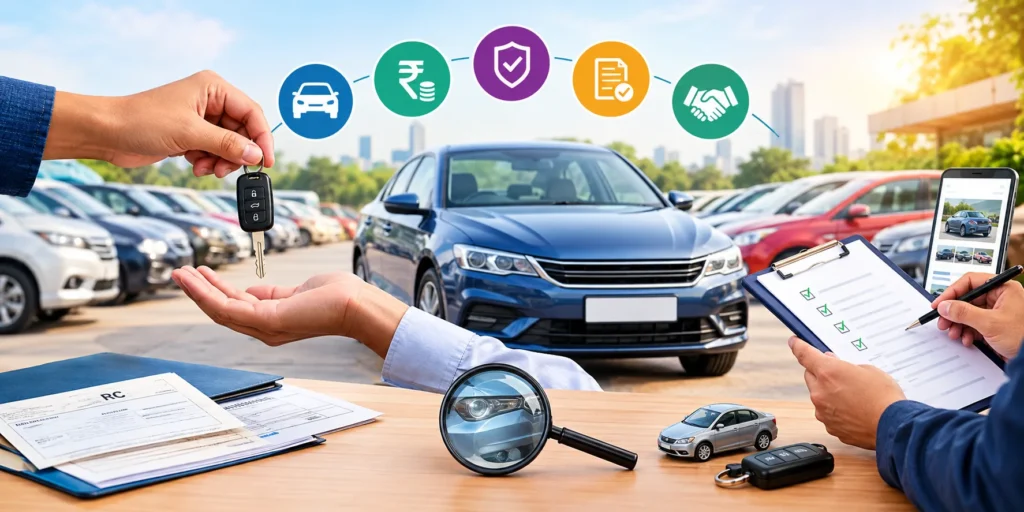
Buying or selling an old car sounds simple.
You find a car, negotiate a price, check some documents, make the payment and transfer the ownership. Or, if you are selling, you put your car online, talk to buyers and wait for someone to offer the right price.
But anyone who has actually dealt with the used-car market knows that it is rarely this simple.
The used-car business in India has its own set of challenges. A car that looks perfect in photographs may have accident repairs. A seller may expect a price based on what they see online, while a buyer may negotiate heavily after inspection. Then there is RC transfer, insurance, pending challans, loan closure, service history and the question that worries almost everyone:
“Am I getting a good car at a fair price?”
This is why understanding the reality of buying and selling used cars is much more important than simply looking at the advertised price.
Why Do People Buy Used Cars?
The biggest reason is obvious: price.
A new car loses value as soon as it becomes a used vehicle. For someone who does not want to spend a large amount on a brand-new car, a pre-owned vehicle can make ownership more affordable.
For example, someone with a budget of ₹5–7 lakh may have considerably more choices in the used-car market than in the new-car market.
A used car can also make sense when:
- You are a first-time car owner.
- You need a second car for the family.
- You drive relatively fewer kilometres.
- You want a higher segment car within a limited budget.
- You want to avoid the initial depreciation associated with a new vehicle.
- You need a car temporarily before upgrading later.
But cheaper purchase price does not automatically mean cheaper ownership.
That is where many buyers make their first mistake.
The Reality of Buying a Used Car
1. The Cheapest Car Is Not Always the Cheapest Car
Suppose you find two similar cars.
Car A: ₹4.20 lakh
Car B: ₹4.60 lakh
Naturally, Car A looks attractive.
But what if Car A immediately needs:
- Four new tyres
- Battery replacement
- Brake work
- AC repair
- Suspension work
- Major servicing
Suddenly, the ₹40,000 difference can disappear very quickly.
This is why you should look at the total ownership cost, not only the purchase price.
Before buying, consider:
Purchase price + immediate repairs + insurance + maintenance + registration-related costs + financing cost
This gives you a much more realistic picture.
2. Odometer Reading Is Not the Whole Story
Mileage is one of the first things buyers look at.
A car showing 45,000 km may appear more attractive than one showing 80,000 km. But the odometer alone cannot tell you how well the vehicle has been maintained.
Look for supporting evidence such as:
- Service records
- Previous invoices
- Tyre condition
- Steering and pedal wear
- Seat condition
- Battery age
- Insurance history
- Workshop records
- Overall mechanical condition
A properly maintained car with higher kilometres can sometimes be a more sensible purchase than a poorly maintained car showing fewer kilometres.
So don’t buy the number on the dashboard. Buy the condition and history of the car.
3. Accident Damage Can Be Difficult to Notice
This is one of the biggest realities of the used-car market.
A professionally repaired car can look surprisingly good.
Fresh paint, polished body panels and a clean interior can make an older vehicle appear almost new.
That’s why a proper inspection matters.
Check for:
- Uneven panel gaps
- Different shades of paint
- Overspray
- Welding marks
- Replaced body panels
- Unusual tyre wear
- Signs of chassis repair
- Airbag-related concerns
- Water or flood damage
If you don’t understand mechanical or bodywork inspection, getting an independent mechanic or inspection professional involved can be worth the money.
4. Service History Can Tell You a Lot
A service history is one of the most useful pieces of information when buying a used vehicle.
It can help answer questions such as:
- Was regular servicing done?
- Where was the vehicle serviced?
- Were major parts replaced?
- Has the car been maintained according to schedule?
- Are there unexplained gaps in maintenance?
A seller who has maintained invoices and service records has more useful information to share with a potential buyer.
However, even a service history should not replace a physical inspection.
The Reality of Selling an Old Car
Selling a car can be just as complicated as buying one.
The seller usually wants the highest possible price.
The buyer wants the lowest possible price.
That difference creates the negotiation.
1. Your Emotional Value Is Usually Different From Market Value
This happens frequently.
You may have spent years with your car and remember every service, repair and accessory you installed.
You might think:
“I have maintained this car very well, so it should be worth ₹X.”
But buyers generally look at:
- Current market prices
- Age
- Kilometres
- Variant
- Condition
- Ownership history
- Accident history
- Demand for that model
- Location
- Number of similar cars available
Your emotional attachment doesn’t increase the resale value.
That’s not necessarily fair or unfair—it is simply how a market works.
2. Private Selling Can Give You More Control, But Also More Work
Selling directly to another person can potentially allow you to negotiate directly.
But you may have to deal with:
- Repeated phone calls
- Low-ball offers
- Test-drive requests
- Multiple inspections
- Negotiations
- Payment verification
- Documentation
- RC transfer
- Insurance-related formalities
- Buyers changing their minds
And there is another issue.
Time has a value too.
If you spend several weekends meeting potential buyers just to eventually sell the car after weeks of negotiation, the slightly higher selling price may not feel as attractive as it looked initially.
3. Dealers Usually Have Their Own Margin
When you approach a dealer, don’t be surprised if the dealer’s purchase offer is lower than the price at which a similar car is eventually advertised.
That’s because a used-car business has expenses.
The business may need to account for:
- Vehicle inspection
- Transportation
- Cleaning and detailing
- Repairs
- Storage
- Staff
- Advertising
- Financing or working capital
- Documentation
- Warranty or after-sales obligations
- Business overhead
- Profit margin
So the dealer’s buying price and the customer’s final selling price are not expected to be identical.
This is an important reality to understand before negotiating.
The Biggest Problem: Information Asymmetry
One of the fundamental problems in the used-car market is information asymmetry.
The seller generally knows more about the vehicle’s history than the buyer.
The buyer may not know:
- Whether the car has had a major accident
- How regularly it was serviced
- Whether the odometer accurately reflects usage
- What repairs are coming soon
- Whether there are outstanding issues
- Whether all documents are in order
This is why trust becomes such an important part of a used-car transaction.
A structured inspection process and transparent documentation can reduce some of this uncertainty.
Don’t Forget the Paperwork
A used-car transaction isn’t complete just because money has changed hands.
Before buying or selling, pay attention to the documentation.
Depending on the circumstances, you may need to deal with:
- Registration Certificate (RC)
- Insurance
- PUC certificate
- Identity/address documentation
- Loan closure/NOC, if applicable
- Sale-related documents
- Pending challans
- Ownership transfer
- Tax or other applicable formalities
Don’t assume that the ownership transfer is automatically complete just because you’ve handed over the car.
Keep records of the transaction and verify the transfer status through the appropriate official channels.
What Should Buyers Check Before Paying?
Here’s a practical checklist.
Mechanical
- Engine condition
- Transmission
- Clutch
- Brakes
- Suspension
- Steering
- AC
- Cooling system
- Battery
Exterior
- Paint mismatch
- Dents
- Scratches
- Panel gaps
- Accident repair signs
- Tyres
Interior
- Seats
- Dashboard
- Electrical controls
- Infotainment
- Power windows
- AC controls
- Warning lights
Documents
- RC
- Insurance
- PUC
- Service records
- Loan/NOC status where applicable
- Pending challans
- Ownership history
During the Test Drive
Don’t just drive around the block.
Pay attention to:
- Starting behaviour
- Engine noise
- Gear shifts
- Braking
- Steering response
- Suspension noise
- AC performance
- Warning lights
- Highway behaviour, where possible
What Should Sellers Do Before Listing Their Car?
You don’t necessarily need to spend a huge amount on cosmetic improvements.
Instead:
- Clean the car properly.
- Collect service records.
- Check insurance validity.
- Keep RC and other documents ready.
- Fix small genuine issues if economically sensible.
- Be honest about known problems.
- Research comparable cars before deciding your asking price.
- Take clear photographs.
- Keep maintenance invoices if available.
- Be prepared for negotiation.
Most importantly, don’t hide a known major problem.
A short-term advantage can turn into a much bigger problem later.
Where Does Spinny Fit Into This?
This is where organised used-car platforms such as Spinny can be useful for people who don’t want to manage every part of the transaction themselves.
Spinny says its vehicles go through a 200-point inspection, and its current buying proposition includes features such as a warranty and a 5-day money-back option, subject to applicable terms.
For sellers, Spinny currently describes a process involving an online valuation, vehicle evaluation at home or at a hub, followed by payment and paperwork support.
That can address several common pain points of the traditional used-car transaction:
Buyer problems
- Uncertainty about vehicle condition
- Difficulty comparing cars
- Inspection concerns
- Negotiation
- Documentation
Seller problems
- Finding genuine buyers
- Repeated negotiations
- Vehicle evaluation
- Payment handling
- RC-transfer-related paperwork
Spinny also states that it purchases the used cars it sells rather than merely acting as a listing marketplace for those vehicles.
A Simple Option to Explore
If you’re planning to sell an old car or purchase a pre-owned car, you can check the available options on Spinny and compare the valuation, vehicle condition, documentation and applicable terms before making a decision:
Check Spinny Used Cars & Car Selling Options
This is an affiliate link. If you use the link and complete an eligible transaction, I may receive a commission at no additional cost to you.
But Is an Organised Platform Automatically Risk-Free?
No.
This is another reality worth mentioning.
A structured platform can reduce some common problems, but buyers should still read the specific terms applicable to the vehicle and transaction.
For example, warranty coverage has conditions, and guarantees or return policies can have eligibility requirements. Spinny itself states that its warranty varies by car category and that its 5-day money-back guarantee is subject to terms and conditions.
So don’t replace one form of blind trust with another.
Inspect. Read. Compare. Verify. Then decide.
Used Cars Are Ultimately About Managing Risk
There is no magical formula that guarantees a perfect used car.
Instead, you’re trying to reduce uncertainty.
Think about the transaction this way:
Lower price ≠ better deal
Higher price ≠ better car
Lower kilometres ≠ better condition
Newer year ≠ automatically better maintained
Beautiful appearance ≠ mechanically healthy
Dealer ≠ automatically bad
Online platform ≠ automatically risk-free
The smart approach is to collect enough information to understand what you are actually buying or selling.
A Practical Used-Car Buying Formula
Before buying, ask yourself these five questions:
1. Is the price reasonable?
Compare similar cars by age, variant, kilometres and location.
2. Do I understand the car’s history?
If not, investigate further.
3. Has the car been independently inspected?
If you’re not confident inspecting it yourself, consider professional help.
4. Are the documents clear?
Don’t postpone documentation checks until after payment.
5. Can I afford the car after purchase?
Keep money aside for insurance, servicing, tyres, battery and unexpected repairs.
If the purchase only works financially when nothing goes wrong, your budget may be too tight.
Final Thoughts
The used-car market in India can be a very practical way to buy or sell a vehicle, but it isn’t as simple as comparing two prices online.
For buyers, the biggest challenge is discovering the real condition and history of the vehicle.
For sellers, the biggest challenge is getting a reasonable price while dealing with negotiations, inspections, genuine buyers and paperwork.
That’s why organised platforms and structured inspection processes have become an option worth considering.
Whether you choose a private sale, dealer, or a platform such as Spinny, don’t rush the transaction simply because the car looks attractive or the price seems tempting.
Check the car. Check the documents. Check the numbers. Understand the terms. Then make the deal.
That small amount of extra work can make a huge difference when you’re dealing with something worth several lakh rupees.