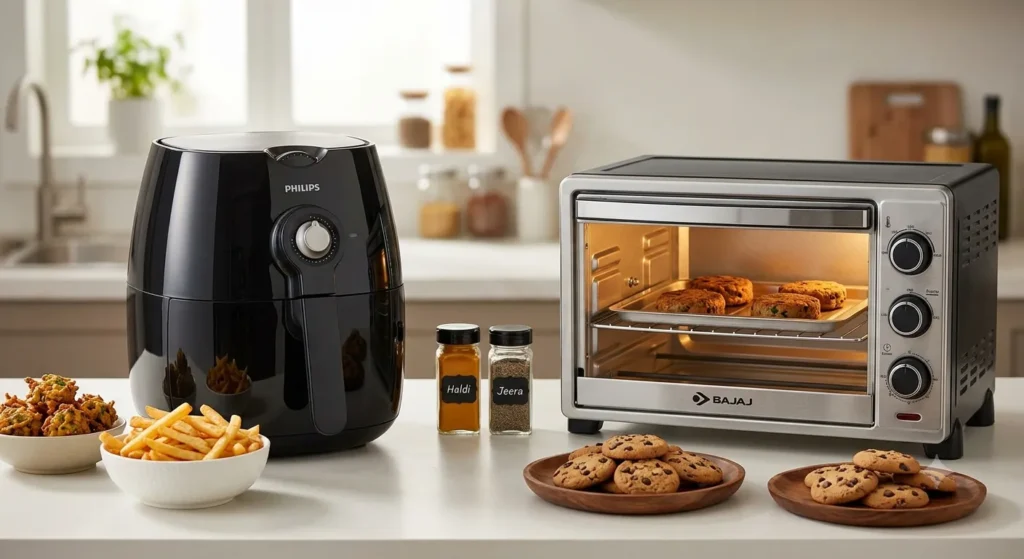
Choosing between an air fryer and an OTG can be confusing, especially when both appliances promise convenient cooking, crispy snacks and delicious homemade food. Although they may appear similar, they work differently and are designed to meet different cooking needs.
An air fryer is particularly useful for preparing crispy snacks, roasted vegetables and small portions of food with little oil. An OTG, which stands for Oven, Toaster and Griller, is better suited to baking cakes, making pizza, toasting bread, grilling and preparing larger batches.
But which appliance is better for your kitchen? Which one consumes less electricity? Can an air fryer replace an OTG? And which one offers better value for money?
In this detailed guide, we will compare both appliances based on cooking performance, versatility, electricity consumption, capacity, cleaning, advantages, disadvantages and suitability for Indian households.
What Is an Air Fryer?
An air fryer is an electric kitchen appliance that cooks food by circulating hot air rapidly around it. Most conventional basket-style air fryers have a heating element and a fan that distributes hot air throughout a compact cooking chamber.
This circulation helps brown and crisp the outside of food without requiring the large quantity of oil used in traditional deep frying.
You can use an air fryer to prepare French fries, potato wedges, paneer tikka, roasted vegetables, chicken pieces, frozen snacks and reheated leftovers. Depending on its size and design, it may also be suitable for small cakes, muffins and other baked items.
Air fryers are available in several designs, including pull-out basket models and larger oven-style models with racks and multiple cooking functions.
Advantages of an Air Fryer
1. Requires less oil
One of the biggest attractions of an air fryer is its ability to prepare many foods with little or no added oil. You can lightly coat potatoes, vegetables or paneer with oil instead of submerging them in a deep fryer.
However, the amount of oil required depends on the recipe and the ingredients. Air-fried food is not automatically healthier in every respect; the nutritional quality still depends on what you cook and how you prepare it.
2. Convenient for everyday cooking
Air fryers are particularly practical for preparing small portions of snacks and side dishes. You can cook a serving of potato wedges, reheat a few samosas or prepare vegetables without using a large oven.
Many models include adjustable temperature settings, timers and preset programs, making them convenient for beginners.
3. Fast cooking for small portions
The compact cooking chamber and strong airflow can help an air fryer heat and cook small batches relatively quickly. Many recipes require less preheating than conventional oven cooking.
Actual cooking time varies according to the food, portion size, appliance design and temperature setting.
4. Crispy results
Air fryers work especially well with foods that benefit from a crisp outer surface. French fries, potato wedges, nuggets and certain frozen snacks can develop a pleasing texture when the food is arranged with enough space for air circulation.
For the best results, avoid filling the basket too tightly. Cooking in batches may be necessary for larger quantities.
5. Convenient for reheating
An air fryer can help restore crispness to leftover pizza, pakoras, samosas and other foods that may become soft in a microwave. You need to monitor the food carefully because reheating for too long can dry it out.
6. Usually easy to clean
Many air fryers have removable baskets and trays that are relatively easy to clean. Some models have dishwasher-safe components, but you should always check the manufacturer’s instructions before washing any part in a dishwasher.
Disadvantages of an Air Fryer
1. Limited usable capacity
Basket-style air fryers have a relatively small cooking area. Even if the advertised capacity looks sufficient, you may need to cook several batches when preparing food for a large family or guests.
2. Not ideal for every type of baking
You can bake small cakes, muffins and other suitable recipes in many air fryers. However, a deep cake tin, large pizza or loaf of bread may not fit comfortably in a basket model.
The strong airflow can also cause uneven results in certain delicate recipes if the temperature, cookware or cooking time is unsuitable.
3. Food may not cook evenly when overcrowded
Air needs to circulate around the ingredients. If you pile food on top of itself, the result may be soft or unevenly browned rather than crispy. Shaking the basket or turning food halfway through cooking can help.
4. Basket cleaning can require effort
Although cleaning is generally straightforward, grease and food particles can become trapped in perforations or mesh surfaces. Burnt-on residue may require soaking and gentle scrubbing.
5. It may not replace a full oven
A standard basket air fryer is not the most convenient option for regular baking, large trays of cookies, multiple pizza portions or recipes that require particular oven-safe dishes.
Who Should Buy an Air Fryer?
An air fryer is a good choice if you:
- Prepare snacks and small meals frequently.
- Prefer cooking with less added oil.
- Want convenient reheating and crisping.
- Have limited kitchen counter space.
- Usually cook for one to four people, depending on the model’s usable capacity.
- Want an appliance that is relatively simple to operate.
Explore an air fryer: Check this air fryer on Amazon
Before buying, compare the basket capacity, usable cooking area, temperature range, power rating, cleaning instructions, warranty and available accessories.
What Is an OTG?
An OTG, or Oven, Toaster and Griller, is an electric countertop oven designed for baking, toasting, grilling and roasting.
Most traditional OTGs use heating elements positioned at the top and bottom of the cooking chamber. Depending on the selected mode, these elements heat the food directly and warm the surrounding air.
Some OTGs also include a convection fan that circulates hot air. Others offer additional features such as a rotisserie, multiple rack positions and adjustable heating modes.
This makes an OTG a versatile appliance for people who enjoy baking at home or preparing different types of oven-cooked dishes.
Advantages of an OTG
1. Better suited to regular baking
An OTG is a practical choice for making cakes, cookies, muffins, bread and pizza. Its larger chamber can accommodate suitable baking tins and trays, allowing you to prepare recipes that may not fit in a basket air fryer.
Results depend on the model, temperature accuracy, rack position and preheating instructions. Regular bakers should pay particular attention to these features.
2. Suitable for grilling and roasting
An OTG can be used for grilling paneer, vegetables and other suitable ingredients. Depending on the recipe and available settings, it can also roast larger portions of food.
For Indian cooking, it can be useful for preparing paneer tikka, tandoori-style vegetables and oven-roasted dishes.
3. More space for larger dishes
Many OTGs offer a larger cooking chamber than basket-style air fryers. This can make them more convenient for preparing larger trays of food, baking multiple items or cooking for family gatherings.
Always check the internal dimensions rather than relying only on the advertised litre capacity.
4. Multiple cooking functions
Depending on the model, an OTG may provide separate top and bottom heating, combined heating, a grill function, a toast setting, convection and rotisserie cooking.
These functions offer flexibility for different recipes. However, not every OTG includes all these features, so check the specifications before purchasing.
5. Useful for people who enjoy experimenting with recipes
If you like trying homemade bread, cookies, cakes, pizzas and baked snacks, an OTG offers the space and cooking control needed for a wider variety of oven-based recipes.
6. Can prepare several portions together
A suitable large OTG may allow you to cook a larger quantity in one cycle. This is particularly helpful when entertaining guests or preparing food for several family members.
Disadvantages of an OTG
1. Usually requires more preheating
Many recipes require an OTG to be preheated before the food is placed inside. This adds preparation time and consumes additional electricity.
The actual preheating requirement depends on the appliance and recipe.
2. Takes up more counter space
An OTG is generally bulkier than a small basket air fryer. You need enough room for the appliance, its door opening, ventilation and safe placement away from unsuitable surfaces or materials.
3. Requires more attention for some recipes
Traditional OTGs may require you to select the correct heating mode, rack position and temperature. Beginners may need some practice to achieve consistent baking results.
4. Cleaning can be more involved
OTGs may require cleaning the interior walls, crumb tray, wire rack, baking tray and door area. Grease and food residue can accumulate if the appliance is not cleaned regularly.
5. Not every OTG produces the same crispness as an air fryer
A conventional OTG without a convection fan may not circulate hot air as aggressively as a dedicated basket air fryer. It can still brown and crisp suitable foods, but results depend on the heating method, tray design and cooking technique.
6. Longer cooking cycles can affect electricity costs
An OTG may consume more total electricity for certain small meals because of preheating and longer cooking times. However, it can be a practical choice for larger batches, and the actual cost depends on the appliance’s power rating, operating time and quantity of food.
Who Should Buy an OTG?
An OTG is a suitable choice if you:
- Regularly bake cakes, cookies, bread or pizza.
- Enjoy grilling and roasting.
- Need room for larger dishes and trays.
- Want several oven-style cooking functions.
- Often cook for a family or prepare food for guests.
- Enjoy experimenting with baking and homemade recipes.
Explore an OTG: Check this OTG on Amazon
Before buying, compare its usable capacity, internal dimensions, temperature control, heating modes, accessories, warranty and whether it includes convection or rotisserie functions.
Air Fryer vs. OTG: Side-by-Side Comparison
The following table summarizes the main differences between these appliances.
| Feature | Air Fryer | OTG |
|---|---|---|
| Main cooking method | Rapid circulation of hot air | Heating elements; some models add convection |
| Best suited for | Crisp snacks, small portions and reheating | Baking, grilling, toasting and larger dishes |
| Oil requirement | Often little or no added oil for suitable foods | Depends on the recipe |
| Cooking speed | Often faster for small batches | Preheating and cooking may take longer |
| Baking | Suitable for smaller recipes if they fit | Generally more practical for regular baking |
| Capacity | Often limited in basket-style models | Often offers more room for trays and dishes |
| Crisping | Particularly convenient for crisp snacks | Depends on heating mode, fan and cookware |
| Grilling | Available for suitable foods | A core function, depending on the model |
| Cleaning | Removable basket and tray | Racks, trays, crumb tray and interior |
| Counter space | Usually compact | Usually requires more space |
| Electricity cost | Can be lower for small portions | Can be practical for larger batches |
| Best for | Convenience and everyday crisping | Versatility and oven-style cooking |
Neither appliance wins in every category. Your cooking habits matter more than the appliance name.
Which Is Better for Indian Cooking?
Both appliances can be useful in an Indian kitchen, but their strengths differ according to the food you prepare.
For samosas, pakoras and frozen snacks
An air fryer is often the more convenient choice for reheating samosas, preparing frozen snacks and crisping suitable leftovers. A light coating of oil may improve browning in some recipes.
An OTG can also heat and crisp snacks, especially when equipped with convection, but you may need to adjust the cooking time and turn the food for even results.
For paneer tikka and roasted vegetables
Both appliances can prepare paneer tikka and roasted vegetables. An air fryer works well for small batches, while an OTG can accommodate larger trays.
Use appropriate skewers and cookware, and confirm that the accessories are suitable for your particular appliance.
For cakes, cookies and pizza
An OTG is generally the better choice for frequent baking. Its larger chamber and rack arrangements make it easier to use different baking tins and trays.
An air fryer can bake smaller cakes and muffins if the cookware fits and the recipe is suitable. However, it is less convenient when you need a large pizza or multiple baking trays.
For toast and grilled food
An OTG is typically more versatile for toasting bread and grilling larger portions. Air fryers can toast or grill certain foods, but the results and available functions vary by model.
For reheating leftovers
An air fryer is especially useful when you want to restore a crispy texture to leftover snacks. An OTG can also reheat food, but it may require more time and energy for small portions.
If your primary requirement is quickly reheating curries, rice or other moist foods, a microwave may be more suitable than either appliance.
Air Fryer vs. OTG: Which Uses Less Electricity?
Electricity consumption is an important consideration, particularly if you intend to use the appliance every day.
However, it is inaccurate to say that every air fryer uses less electricity than every OTG. The result depends on the appliance’s rated wattage, heating cycle, preheating time, cooking duration and amount of food prepared.
You can estimate electricity consumption with this simple formula:
Electricity consumed (kWh) = Power rating (watts) × Operating time (hours) ÷ 1,000
For example, consider two hypothetical cooking sessions:
- An air fryer rated at 1,500 watts operating for 20 minutes would consume approximately 0.5 kWh if it drew its full rated power continuously.
- An OTG rated at 1,800 watts operating for 40 minutes would consume approximately 1.2 kWh under the same simplified assumption.
These are illustrative calculations, not measured results. Actual consumption can be lower because heating elements cycle on and off, and the cooking times may differ.
To estimate the electricity cost, multiply the energy consumed in kWh by your electricity tariff per unit.
For a fair comparison, consider the same food quantity and similar cooking results. An air fryer may be more economical for a small batch of fries, while an OTG may make more sense when preparing a full tray of food.
Which Appliance Is Easier to Maintain?
Maintenance affects convenience, hygiene and the useful life of your appliance.
Air fryers generally have fewer removable cooking components, although their baskets and perforated trays can trap grease. Allow the appliance to cool before cleaning, use non-abrasive cleaning tools and follow the manufacturer’s guidance for the basket coating.
OTGs require attention to the racks, baking trays, crumb tray and inner chamber. Remove food residue regularly and avoid using harsh chemicals or abrasive materials unless the manufacturer specifically permits them.
For either appliance:
- Unplug it and let it cool before cleaning.
- Do not immerse the electrical body in water.
- Keep heating elements and ventilation openings clear.
- Avoid metal utensils that may damage non-stick coatings.
- Follow the manufacturer’s instructions for cleaning and storage.
If easy daily cleaning is your main priority, a basket-style air fryer may be more convenient. If you bake frequently, be prepared to clean your OTG trays and interior regularly.
Important Buying Tips Before You Choose
Before spending money on either appliance, ask yourself the following questions.
1. What will you cook most often?
Choose an air fryer if you mostly prepare crisp snacks and small meals. Choose an OTG if baking, grilling and roasting are more important.
2. How many people do you usually cook for?
Consider the actual basket or tray dimensions and the amount of food you can prepare without overcrowding. Larger households may need a bigger appliance or multiple cooking batches.
3. How much counter space do you have?
Measure the available space and leave the clearance specified in the product manual. Remember to account for doors, handles, ventilation and access to electrical sockets.
4. Which features do you really need?
For an air fryer, look at basket capacity, temperature settings, timer controls and cleaning requirements.
For an OTG, check the temperature range, rack positions, heating modes, included trays and whether convection or rotisserie is available.
5. What is your total budget?
Do not compare appliances on purchase price alone. Consider warranty coverage, accessories, replacement parts, electricity use and the features you will genuinely use.
6. Check reviews and product specifications
Read recent buyer reviews and examine the exact product listing before placing an order. Pay attention to comments about cooking consistency, temperature accuracy, durability and after-sales support.
Can an Air Fryer Replace an OTG?
An air fryer can replace an OTG for some households, but not for every cooking requirement.
If you rarely bake and mainly prepare snacks, vegetables, small portions of roasted food and reheated leftovers, a good air fryer may cover most of your needs.
However, if you regularly make cakes, cookies, bread, pizzas or large grilled dishes, an OTG remains the more practical option.
There is also a middle-ground option: an oven-style air fryer or an OTG with a convection fan. These appliances combine a larger cooking chamber with circulating hot air, although their performance and functions vary considerably. Check the exact specifications before deciding that a combination model can replace both appliances.
Frequently Asked Questions
1. Is an air fryer healthier than an OTG?
Neither appliance automatically makes food healthy. An air fryer can reduce the amount of added oil required for many foods compared with deep frying. An OTG can also prepare dishes with relatively little oil, depending on the recipe. Ingredients, portion sizes and cooking methods remain important.
2. Can I bake a cake in an air fryer?
Yes, many air fryers can bake small cakes and muffins if the tin fits and the appliance supports the required temperature. Follow a suitable recipe and monitor the cooking process. An OTG is generally more convenient for regular baking and larger cakes.
3. Is an OTG good for everyday cooking?
Yes. An OTG is useful for baking, grilling, roasting, toasting and preparing larger quantities of food. However, it may be less convenient than an air fryer when you only want to cook a small snack quickly.
4. Which is better for a small family?
An air fryer may be the better option if your family mainly prepares small portions of snacks and side dishes. An OTG may be preferable if you regularly bake or need more room for different dishes. Choose capacity according to your actual cooking habits.
5. Does an air fryer need oil?
Not always. Some foods cook well without added oil, while others benefit from a light coating. Using a small amount of oil may improve browning and texture, depending on the ingredients.
6. Can an OTG make food crispy?
Yes. An OTG can brown and crisp food, but the result depends on its heating mode, temperature, cookware and cooking technique. Models with convection may improve air circulation.
7. Should I buy both an air fryer and an OTG?
You may benefit from owning both if you frequently prepare crispy snacks and also bake or grill larger dishes. If you have a limited budget or kitchen space, start with the appliance that best matches your most common cooking tasks.
Final Verdict: Air Fryer or OTG?
There is no universal winner in the air fryer vs. OTG comparison. The right choice depends on what you cook, how much you prepare and how often you use the appliance.
Choose an air fryer if you want convenient everyday cooking, crispy snacks, easy reheating and reduced oil usage for suitable recipes. It is particularly practical for smaller portions and households with limited kitchen space.
Choose an OTG if you enjoy baking cakes, cookies, bread and pizza, or if you need greater flexibility for grilling, roasting and larger dishes.
If you mostly cook snacks and small meals, start by exploring this air fryer on Amazon. If baking and oven-style cooking are your priorities, compare the features of this OTG on Amazon.
Before buying, verify the latest price, product specifications, warranty, included accessories and customer reviews on the retailer’s website.
The best appliance is not necessarily the one with the most features. It is the one that makes your regular cooking easier, fits your kitchen and offers good value for your money.