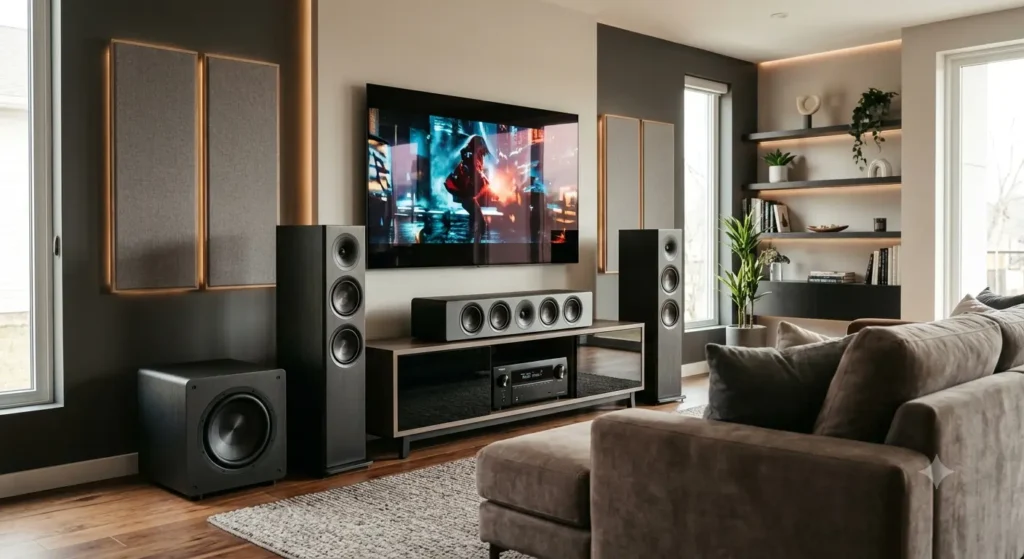
When setting up a high-performance home entertainment area, visual quality often takes center stage—yet sound is what truly shapes the emotional impact of movies, gaming, and music. Built-in television speakers lack the acoustic chamber volume and hardware required to deliver realistic weight, crisp dialogue, and multi-dimensional surround effects.
To build an exceptional listening space, it is essential to understand the underlying parameters of high-fidelity audio, the architectural configurations available, and how room acoustics impact real-world performance.
What Defines Sound Quality in a Home Audio System?
Evaluating audio equipment requires looking beyond raw wattage ratings. High-quality sound depends on how cleanly an audio signal is amplified and translated into physical acoustic waves. The core characteristics that determine a sound system’s quality include:
1. Frequency Response and Tonal Balance
Frequency response refers to the range of audible sound frequencies a speaker system can reproduce, measured in Hertz (Hz) to Kilohertz (kHz). Human hearing spans approximately 20 Hz to 20,000 Hz (20 kHz).
- Low Frequencies (20 Hz – 250 Hz): Governed by subwoofers, low frequencies deliver tactile impact and resonance for action sequences and deep basslines.
- Mid-Range Frequencies (250 Hz – 4,000 Hz): The most critical band for human speech, vocals, and central instrumentation. A quality system prevents midrange frequencies from sounding muffled or overshadowed by heavy bass.
- High Frequencies (4,000 Hz – 20,000 Hz): Handled by tweeters, high frequencies supply detail, airiness, and directional cues like footsteps or subtle ambient sound effects.
A high-quality system maintains a flat frequency response, meaning it reproduces all audio frequencies smoothly without unnaturally boosting bass or harsh treble.
2. Total Harmonic Distortion (THD)
THD measures the degree to which an amplifier or speaker alters the original audio signal. Expressed as a percentage, a lower THD value indicates higher signal purity. Premium home audio components generally maintain a THD under 0.1% at normal listening volumes, ensuring crisp, fatigue-free audio playback even during dynamic peaks.
3. Dynamic Range and Transient Response
Dynamic range is the gap between the quietest whisper and the loudest explosion a system can output without clipping or distortion. Transient response reflects how quickly a speaker driver can react to sudden signal changes (such as a sharp drum hit or glass shattering). Drivers constructed from rigid, lightweight materials—like Kevlar, aluminum, or silk domes—offer fast transient responses and minimal cabinet resonance.
4. Soundstage and Imaging
- Soundstage refers to the perceived physical width, depth, and height of the audio environment.
- Imaging is the system’s ability to pinpoint specific instruments or audio objects precisely within that space. High-fidelity systems create a seamless sonic environment where audio moves fluidly around the listener.
Exploring Sound System Architecture: Which Setup Fits Your Needs?
Selecting the right physical configuration depends on your room size, installation preferences, and functional needs.
+--------------------------------------------------------------------------+
|                       HOME AUDIO SYSTEM TYPES                            |
+--------------------------------------------------------------------------+
        |                                   |
        v                                   v
+-----------------------+         +----------------------------------+
|      SOUNDBARS        |         |    COMPONENT SURROUND SYSTEMS    |
| (Compact, Plug-Play)  |         |   (Immersive, AV Receiver Based) |
+-----------------------+         +----------------------------------+
        |                                   |
        +----------> Channels <-------------+
                          |
      +-------------------+-------------------+
      |                   |                   |
      v                   v                   v
   2.1 Channel         5.1 Channel       7.1.4 Channel
 (Left, Right, Sub)   (Surround Sound)   (3D Dolby Atmos)
| System Configuration | Best Suited For | Key Advantages | Considerations |
| Soundbars (2.1 / 3.1 Channel) | Apartments, bedrooms, small living spaces | Sleek design, easy setup, clean cable management | Limited physical sound separation compared to discrete speakers |
| 5.1 Channel Surround Systems | Standard dedicated media rooms | Authentic surround immersion, dedicated center channel for vocals | Requires rear speaker placement and wire routing |
| 7.1.4 Object-Based Audio (Dolby Atmos / DTS:X) | Dedicated home theaters and enthusiast spaces | 3D sound hemisphere with overhead height channels | Higher budget, requires multi-channel AV Receiver |
For those looking to explore an optimized high-performance setup, check out this featured top-rated home sound system on Amazon: Explore the Recommended Sound System on Amazon.
Essential Hardware and Connectivity Features
To get the most out of modern high-resolution audio formats, pay close attention to system hardware and input standards:
- HDMI eARC (Enhanced Audio Return Channel): HDMI eARC provides the bandwidth necessary to transmit uncompressed audio formats like Dolby TrueHD, DTS-HD Master Audio, and multi-channel LPCM directly from your TV to your sound system.
- Active vs. Passive Speakers: Powered (active) speakers integrate internal amplifiers, making them compact and simple to connect. Passive speakers require an external AV Receiver or power amplifier, allowing for modular upgrades and finer acoustic tuning.
- Digital Signal Processing (DSP) & Room Calibration: Modern audio receivers and high-end soundbars feature automated acoustic correction. Using calibration microphones, the system analyzes your room’s acoustic reflections and adjusts speaker distance delay and EQ settings automatically.
- Wireless Streaming Integration: Modern systems should support high-resolution wireless streaming standards like Wi-Fi audio, Apple AirPlay 2, Spotify Connect, and Bluetooth 5.0+ with high-definition codecs (such as LDAC or aptX HD).
Optimizing Room Placement and Acoustic Layout
Even elite audio hardware underperforms if speaker placement and room acoustics are ignored. Follow these acoustic best practices to maximize sound quality:
Speaker Positioning Guidelines
- The Equilateral Triangle: Position your primary left and right stereo speakers at equal distances from each other and your main listening seat, angled inward toward your ears.
- Ear-Level Alignment: Tweeters should be positioned at ear level when seated.
- Center Channel Alignment: Place the center speaker directly above or below the TV screen, aimed at ear height to keep movie dialogue anchored to the screen.
- Subwoofer Placement: Avoid placing subwoofers directly in corners, which can cause boomy, unbalanced bass response. Placing subwoofers slightly off-wall or using room-mode boundary testing helps ensure tight, articulate low-end performance.
Pro Tip for Room Acoustics: Hard surfaces like glass windows, hardwood floors, and bare walls reflect sound waves, creating flutter echoes that compromise audio clarity. Introducing soft furnishings, thick rugs, heavy curtains, or acoustic wall panels absorbs early reflections and noticeably tightens vocal clarity and soundstage imaging.
Choosing the Ideal Setup for Your Space
Building the ultimate audio configuration comes down to matching components with your room size, usage patterns, and budget:
- For Compact Living Spaces & Apartments: A multi-driver 3.1 soundbar equipped with a compact wireless subwoofer delivers clear TV dialogue, dynamic movie sound, and minimalist aesthetic appeal without cluttering your floor.
- For Medium-Sized Living Rooms: A dedicated 5.1 channel speaker system powered by a modern AV receiver provides distinct channel separation, expansive audio coverage, and authentic cinematic surround sound.
- For Large Media Rooms & Dedicated Home Theaters: An immersive 7.1.4 object-based setup featuring floor-standing tower speakers, overhead height speakers, and dual subwoofers delivers full 3D audio precision.
Investing in a balanced, high-fidelity audio system elevates every film, soundtrack, and game—transforming casual viewing into an immersive cinematic experience right in your living room.
Would you like tailored recommendations based on your specific room dimensions, budget, or preferred audio sources (e.g., movies, gaming, or vinyl)?